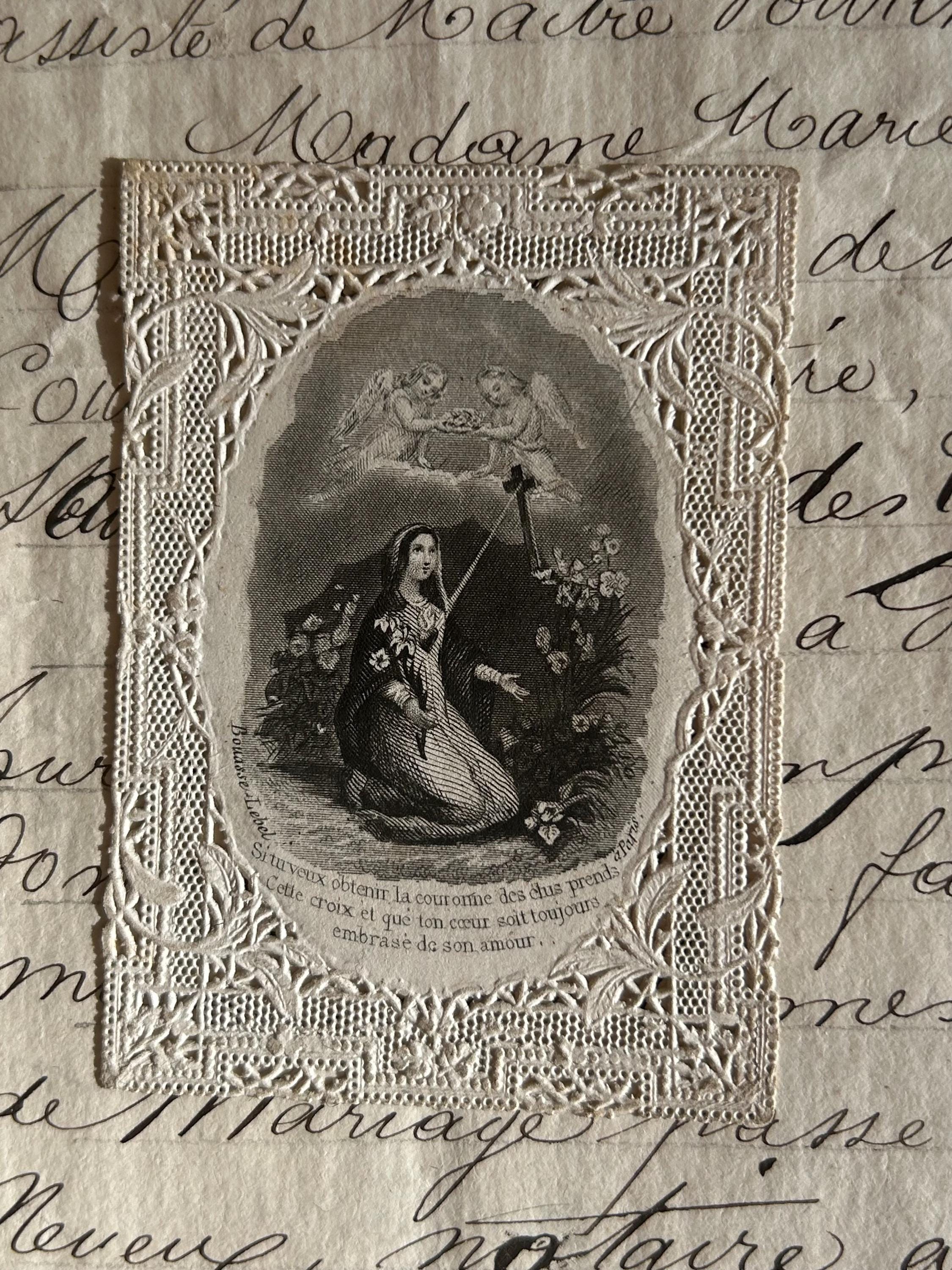
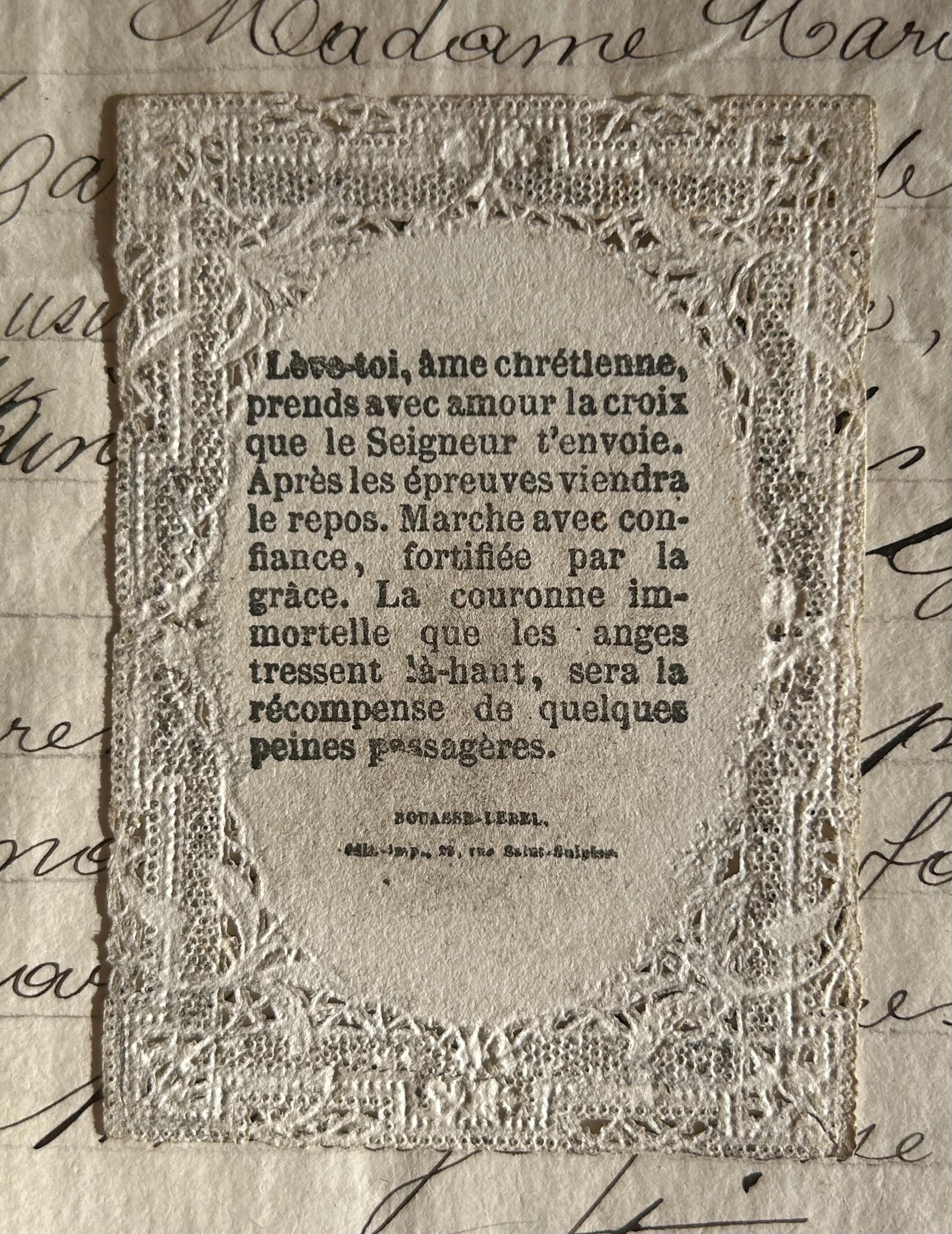
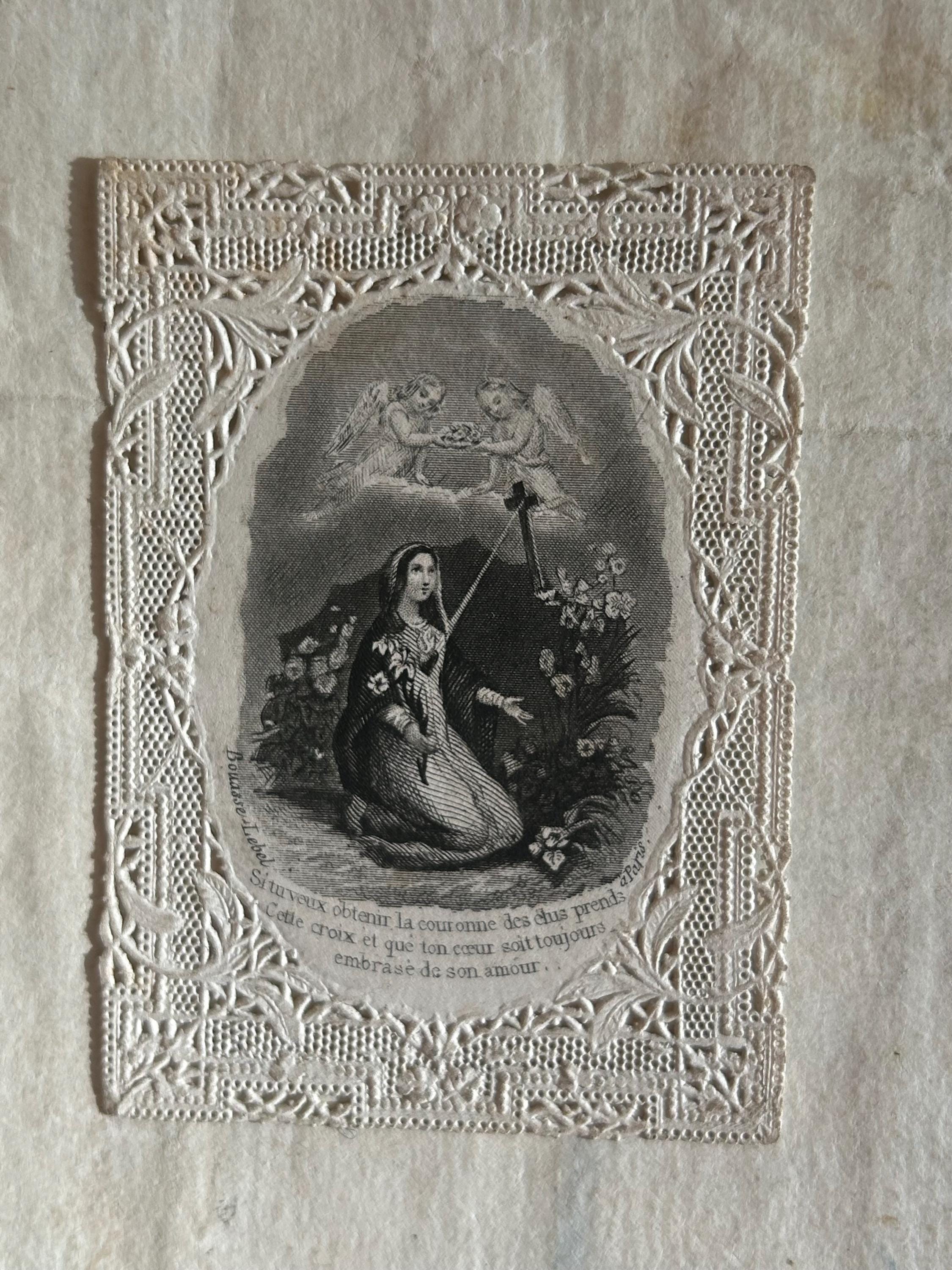
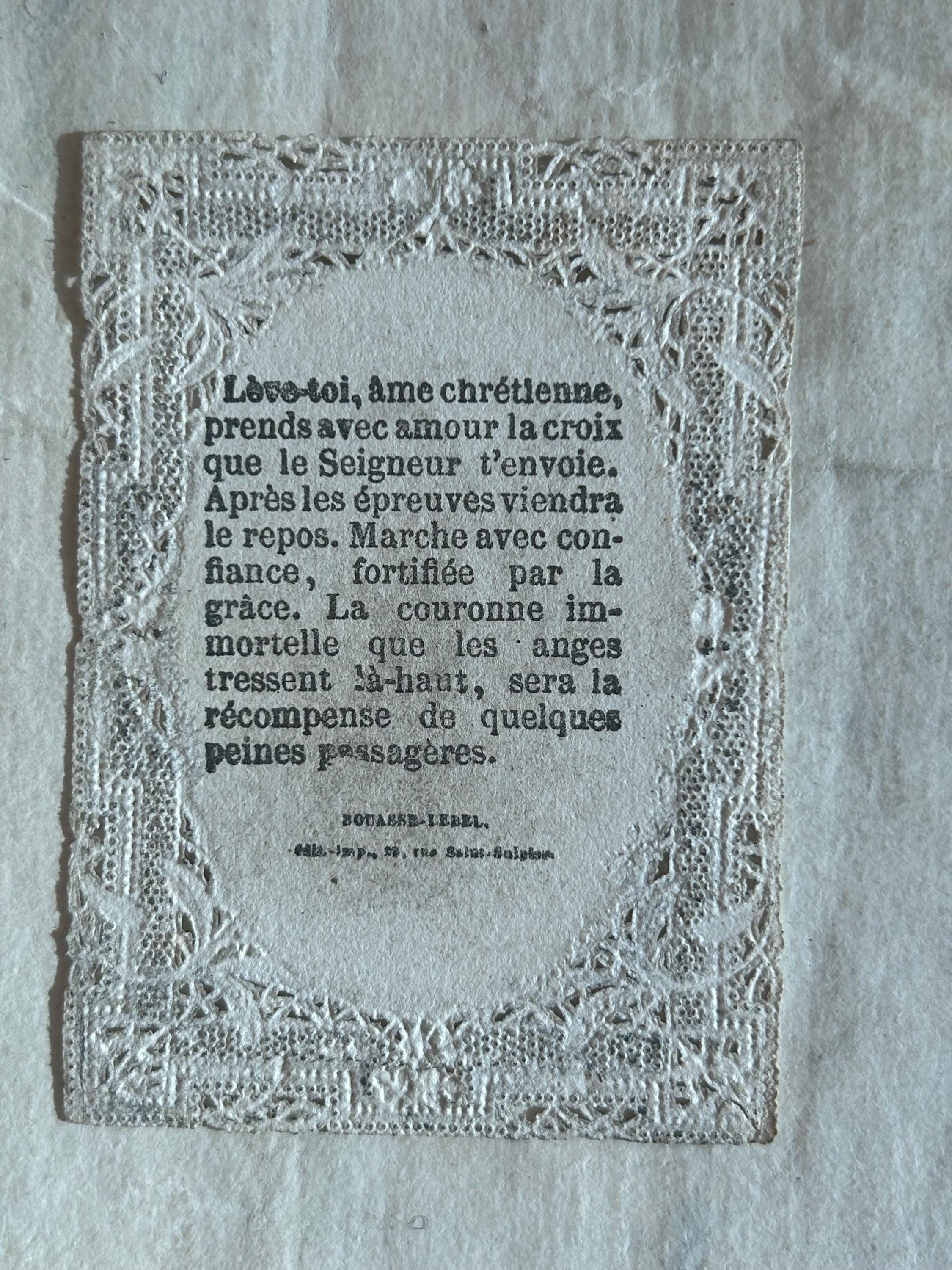
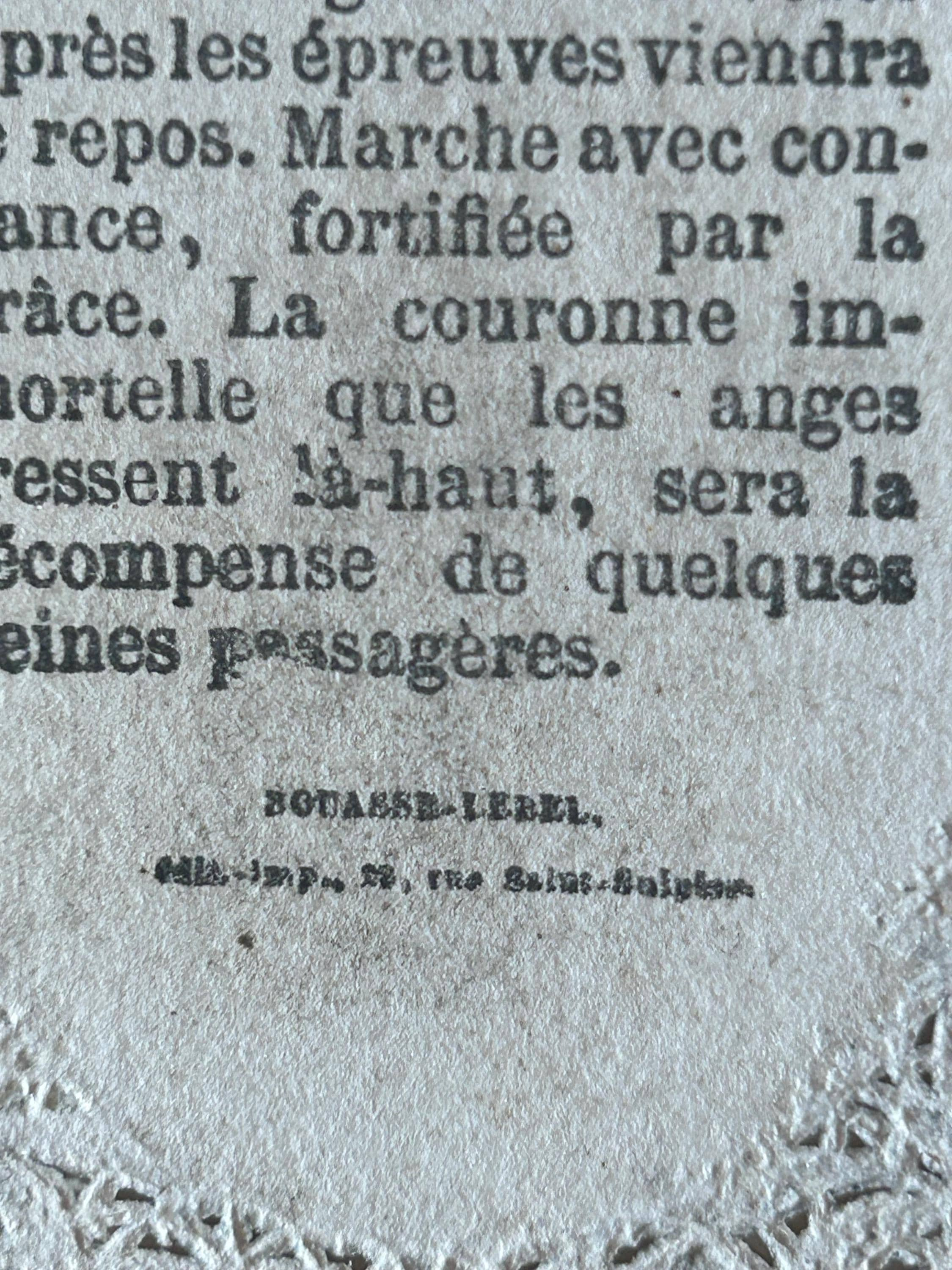
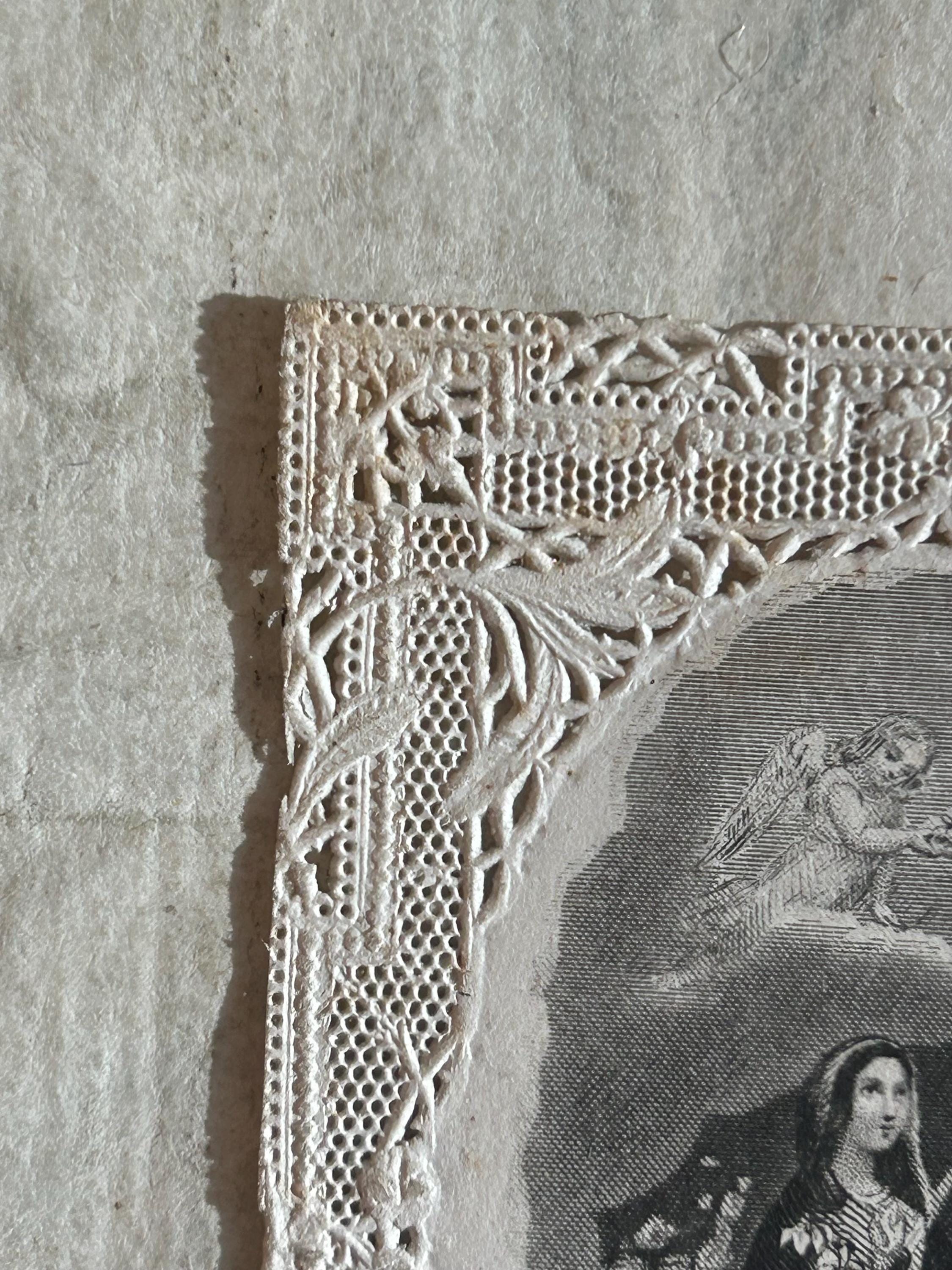
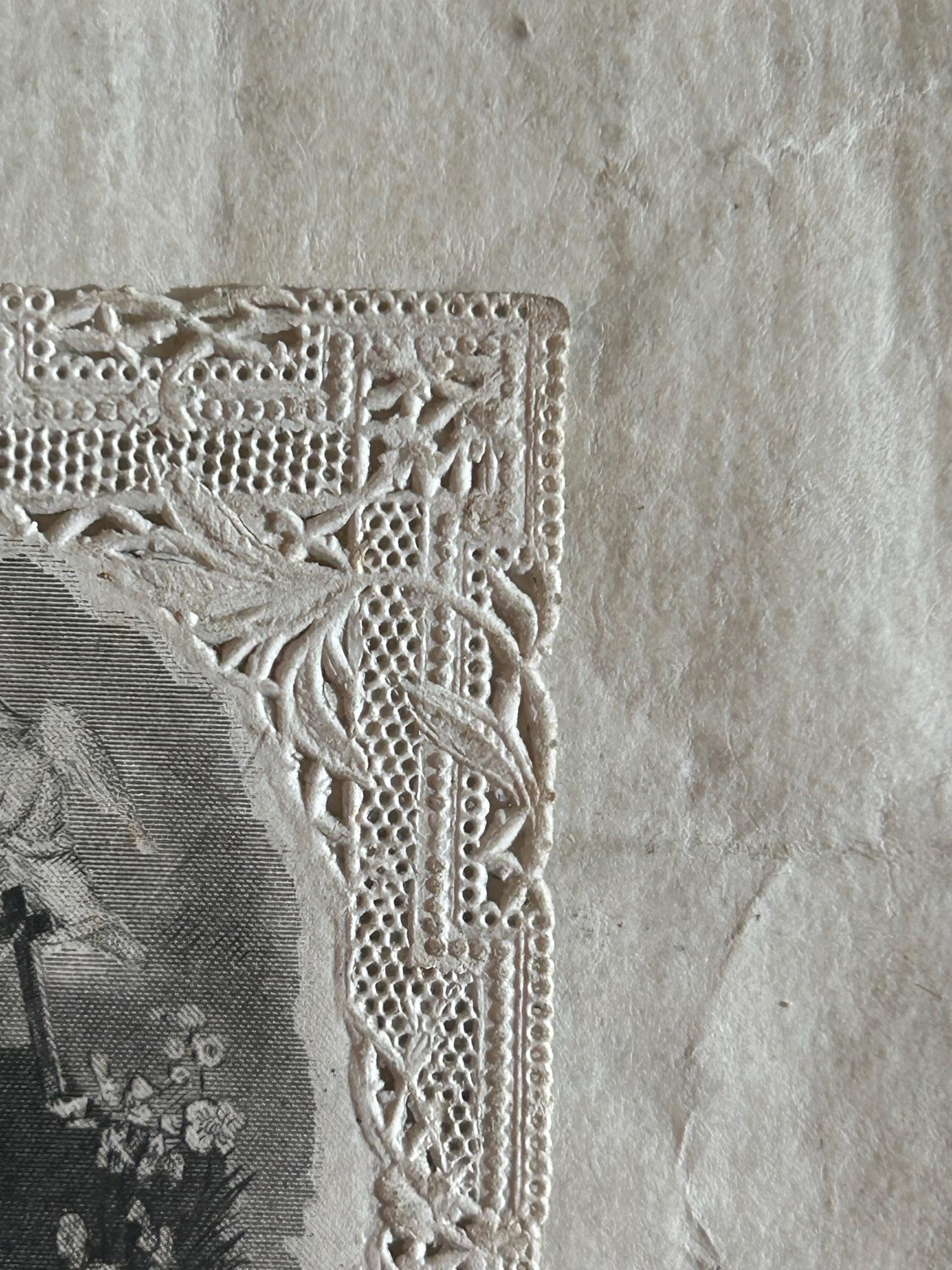
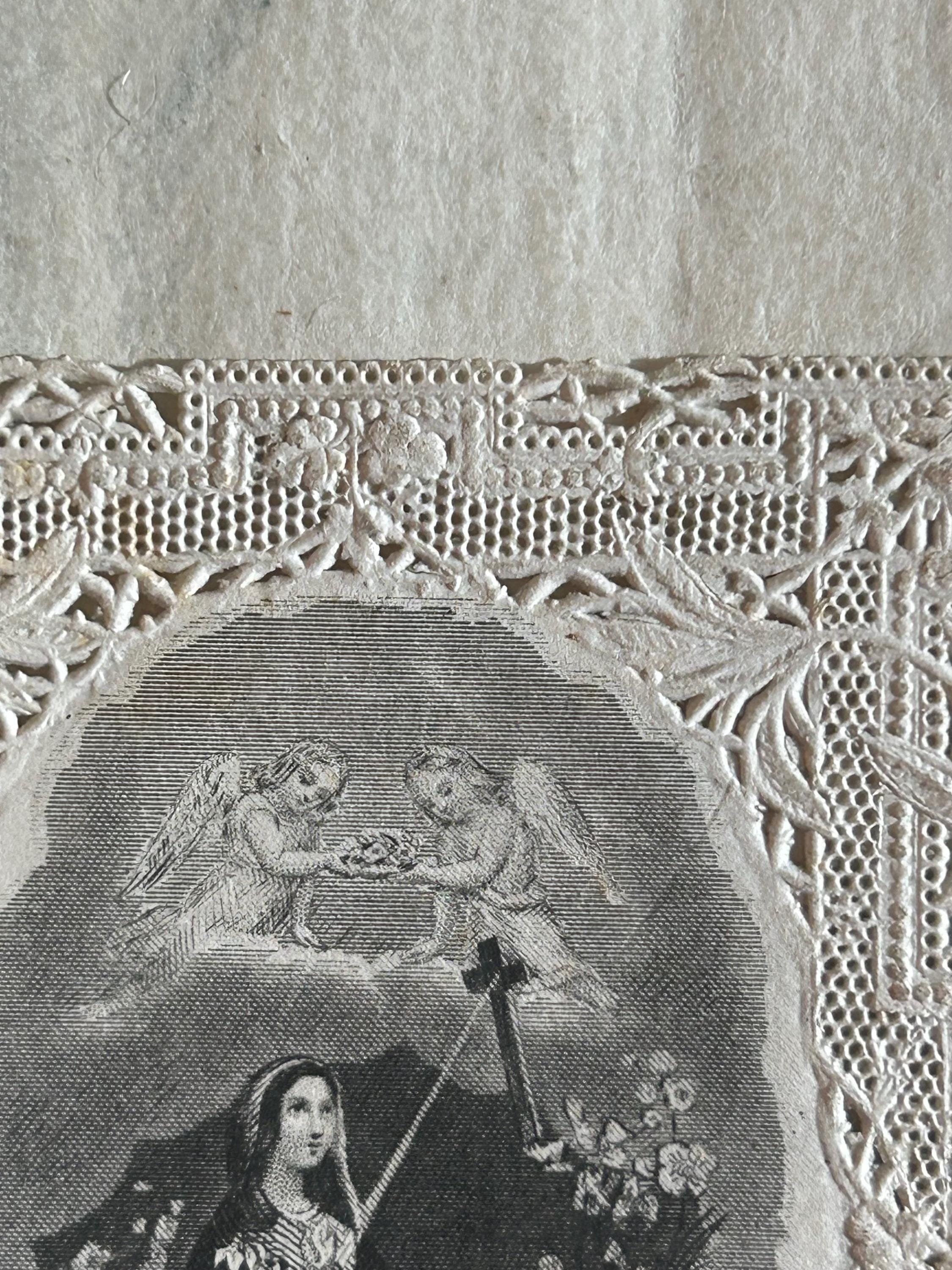
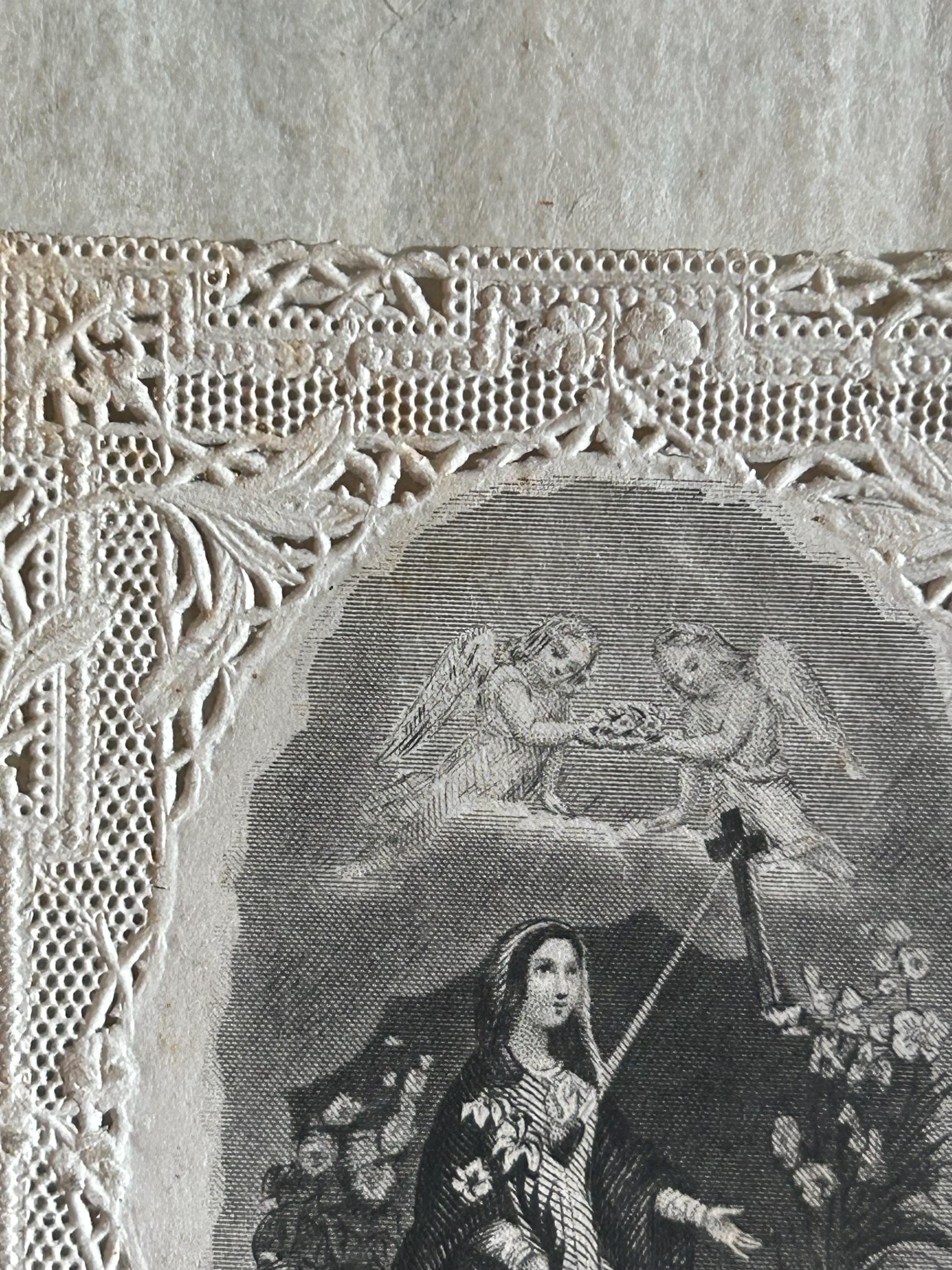
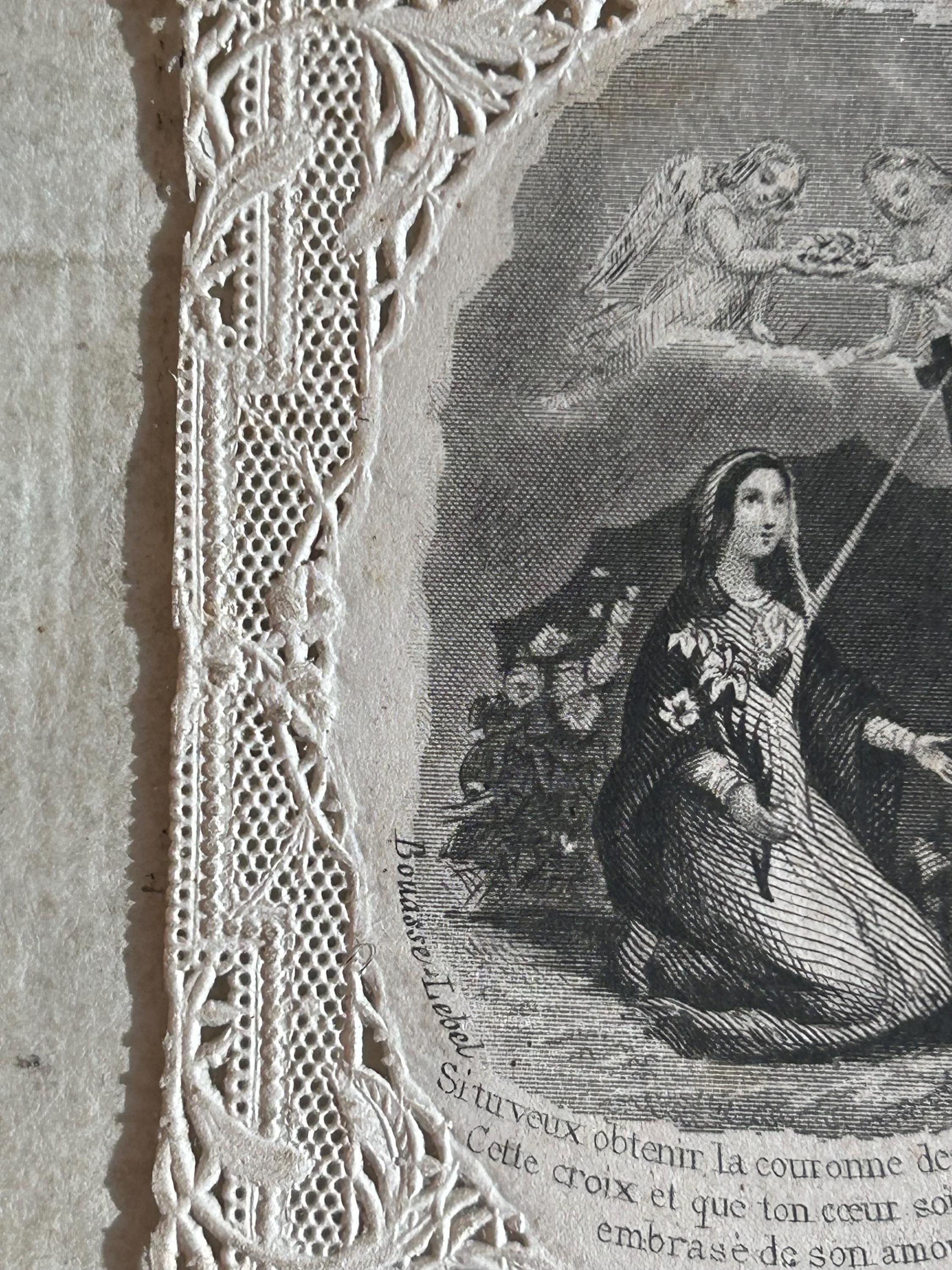
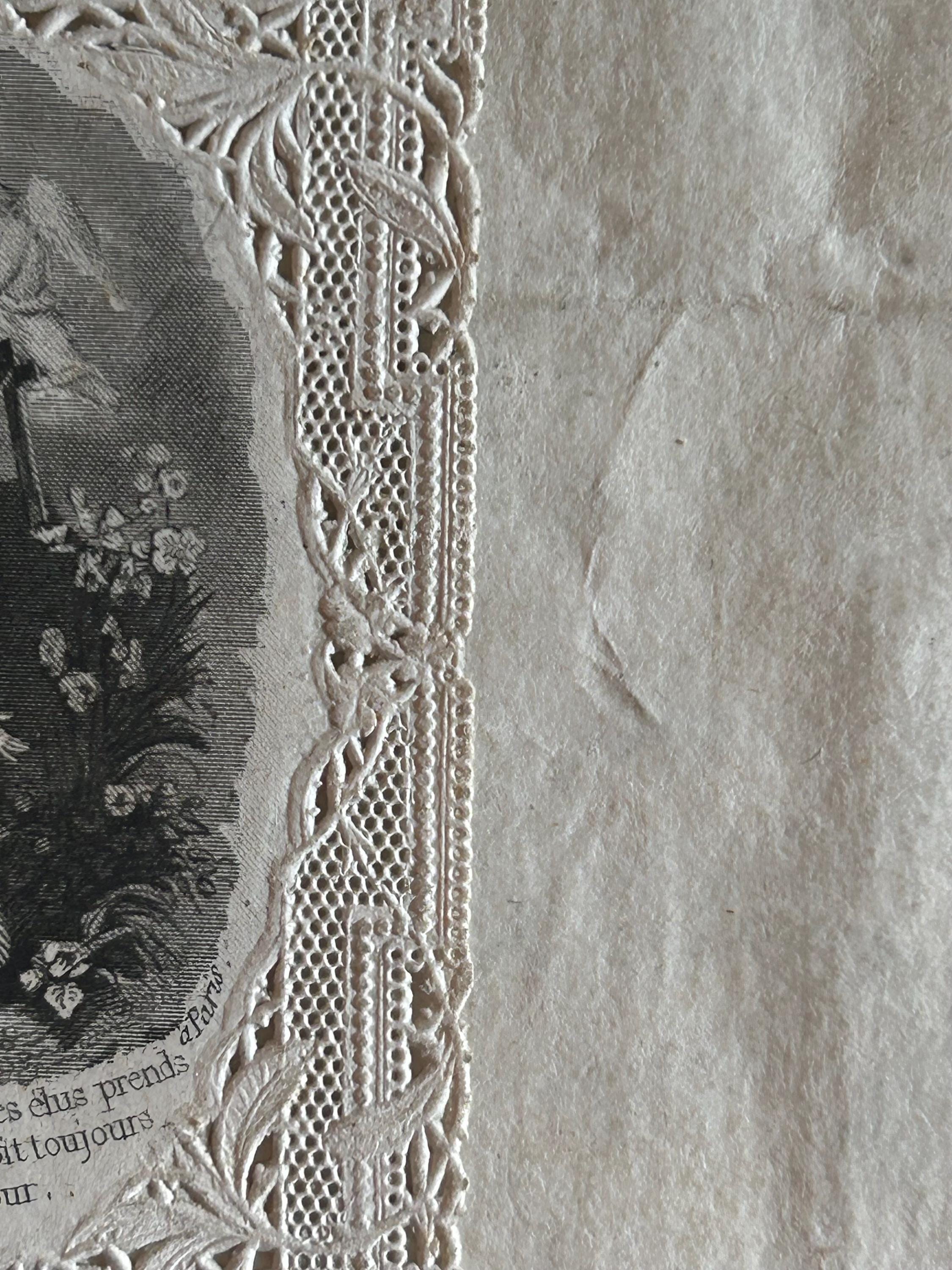
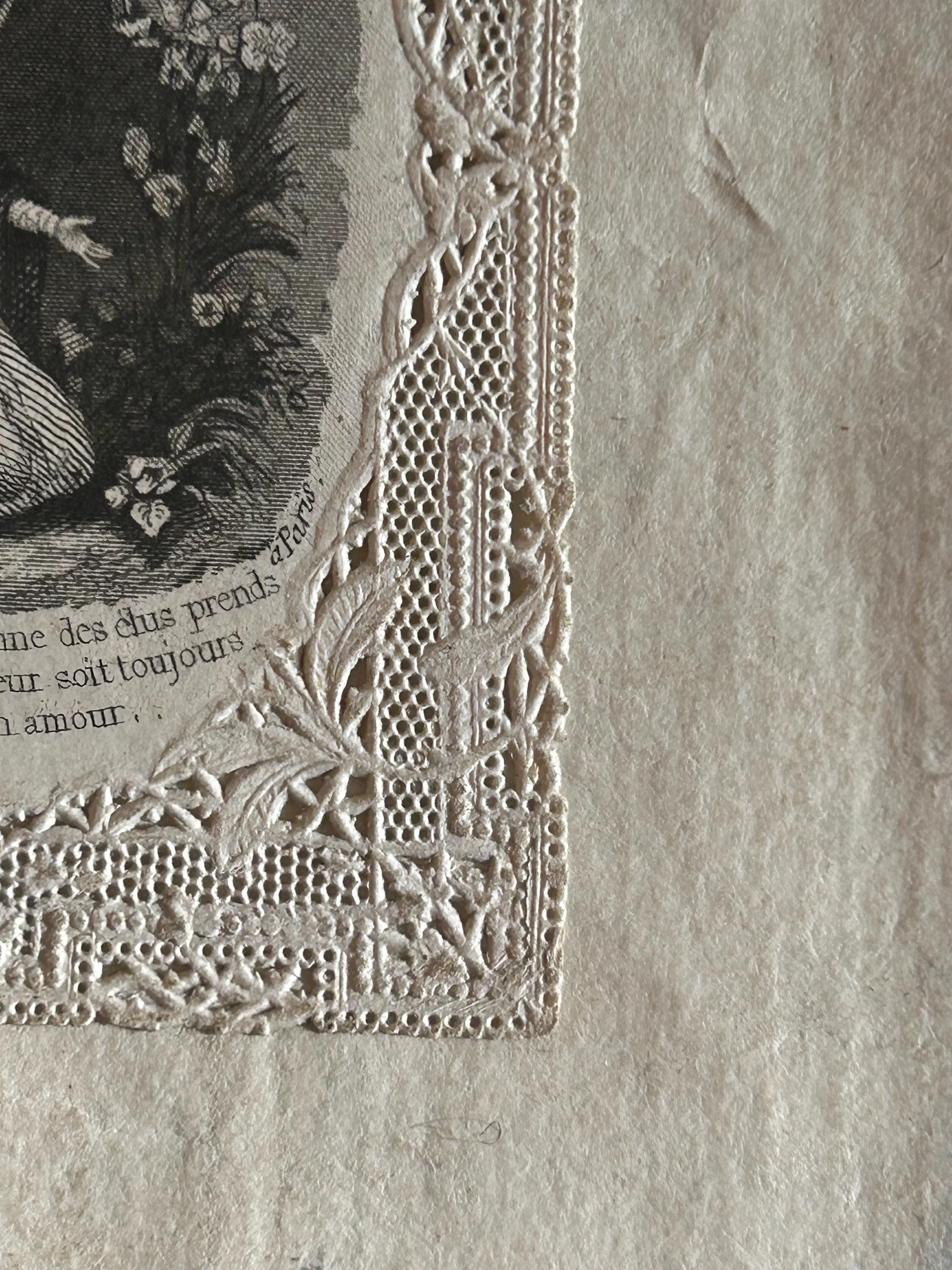
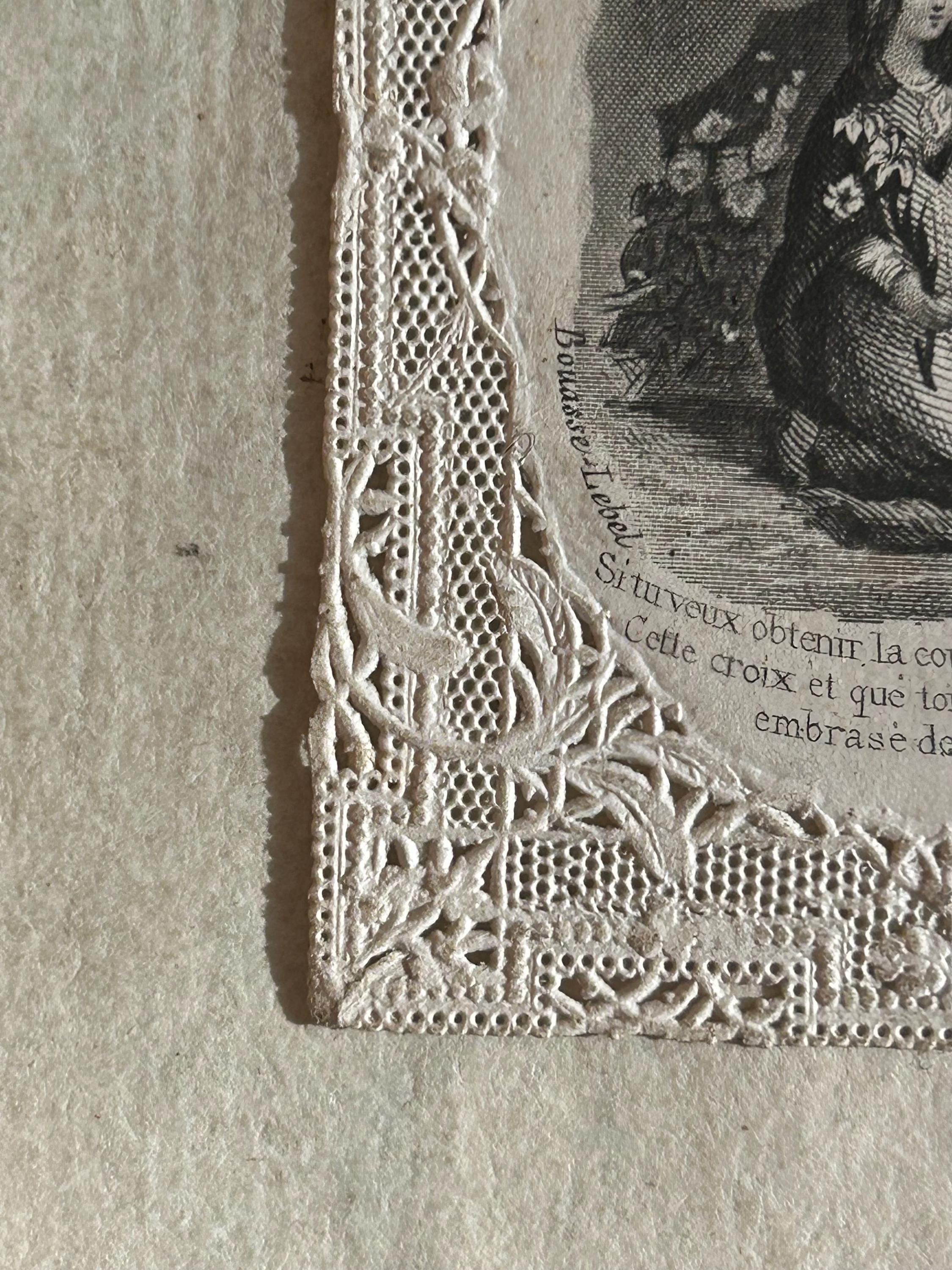
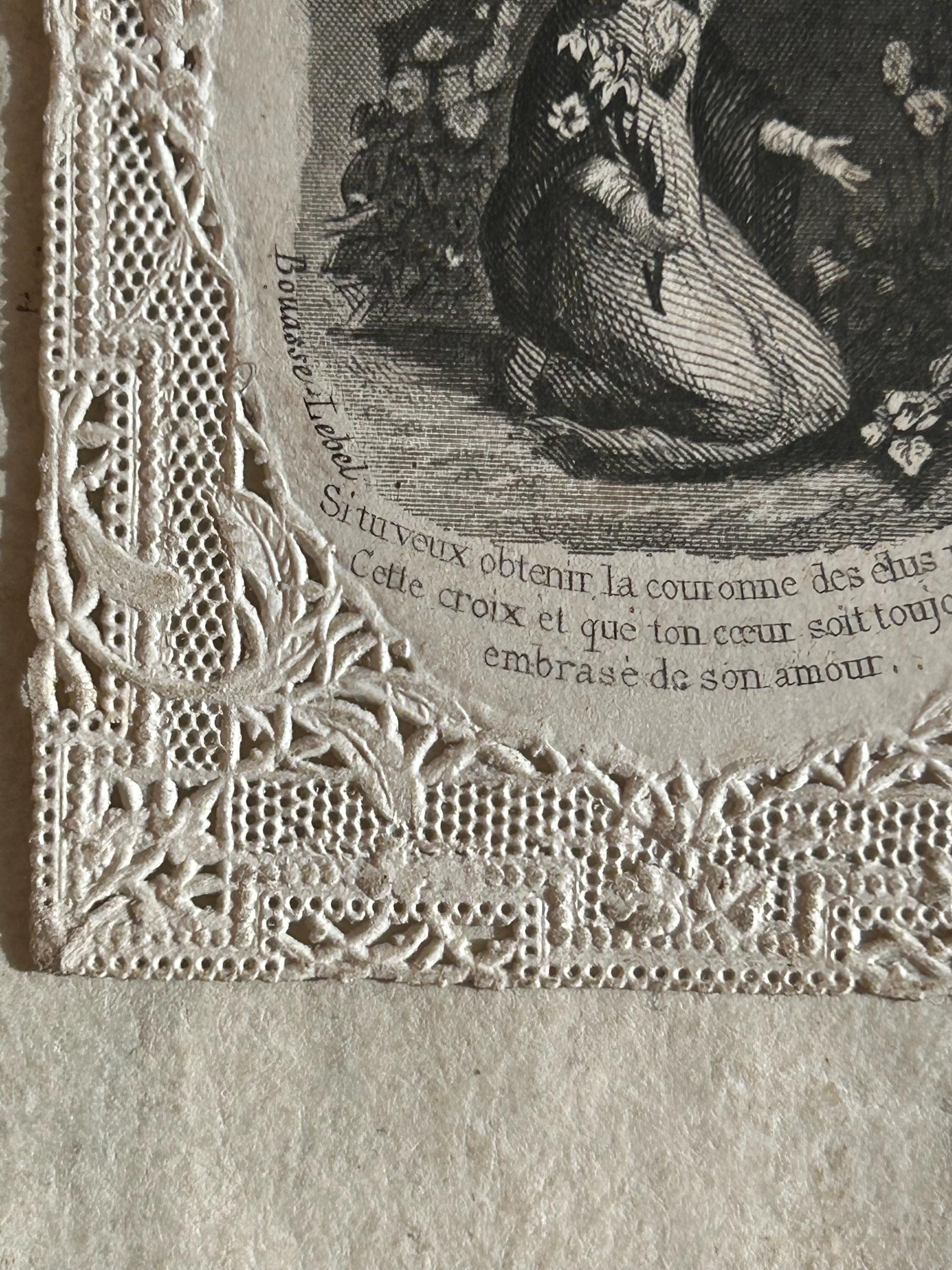
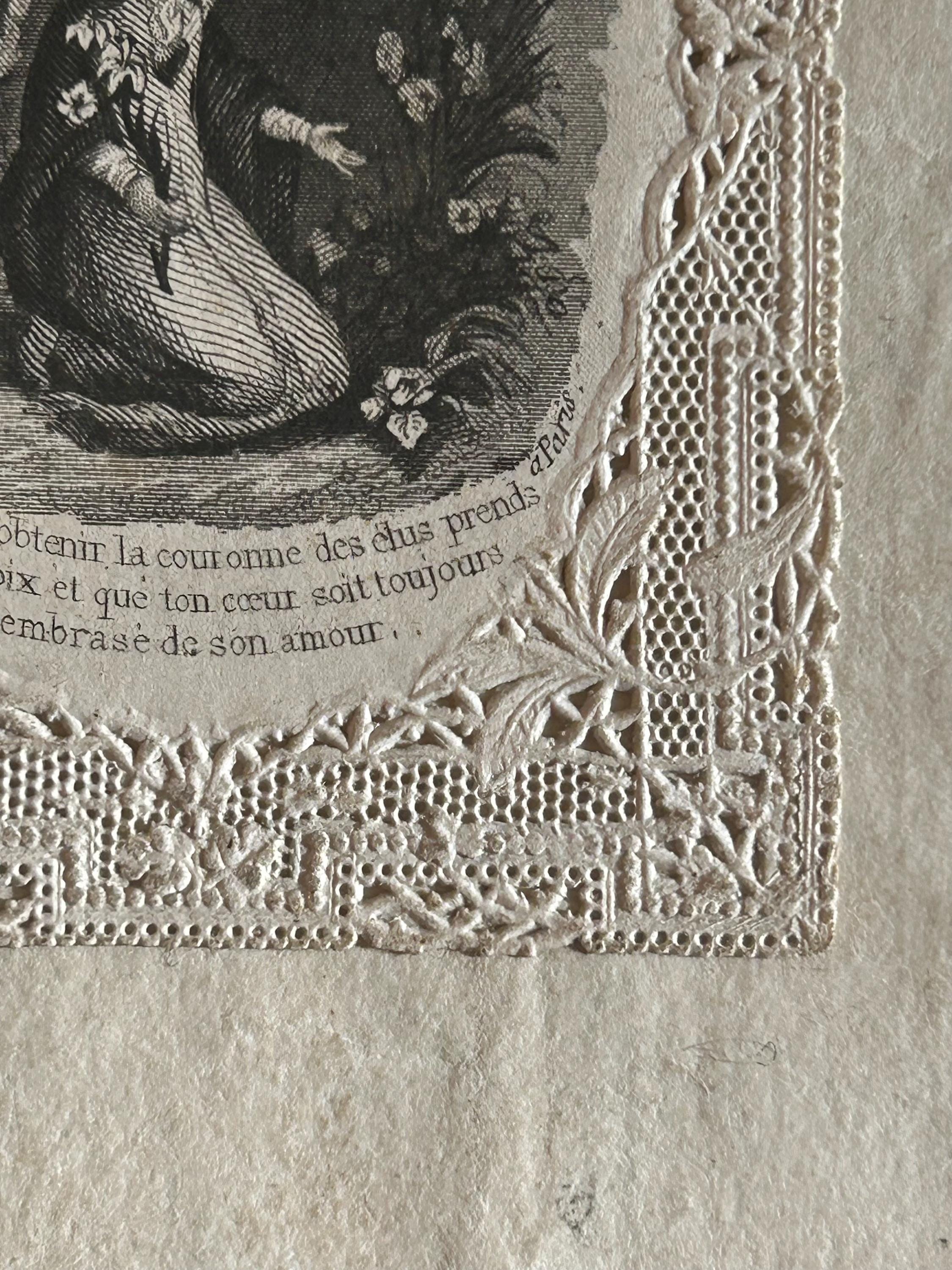
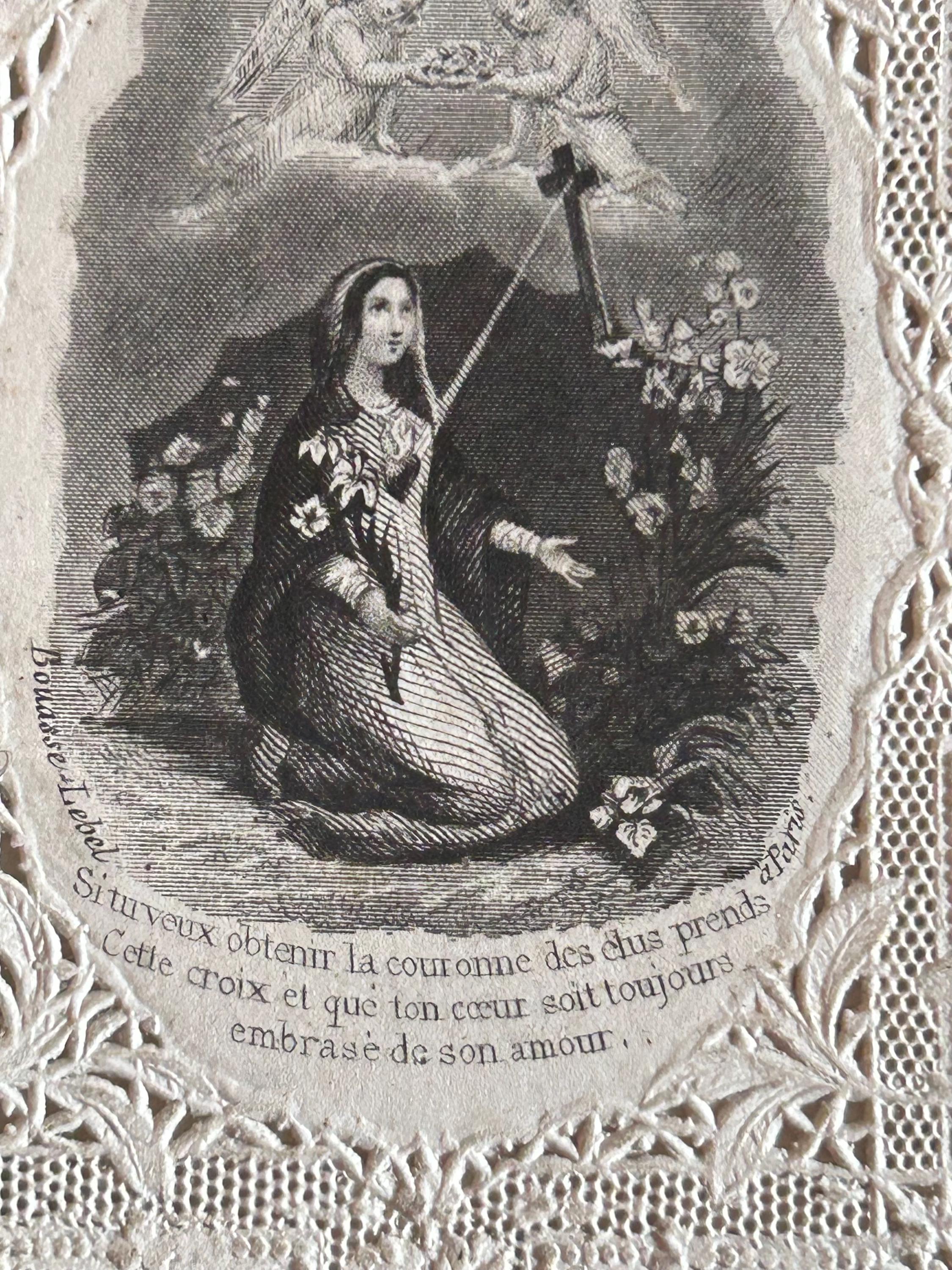
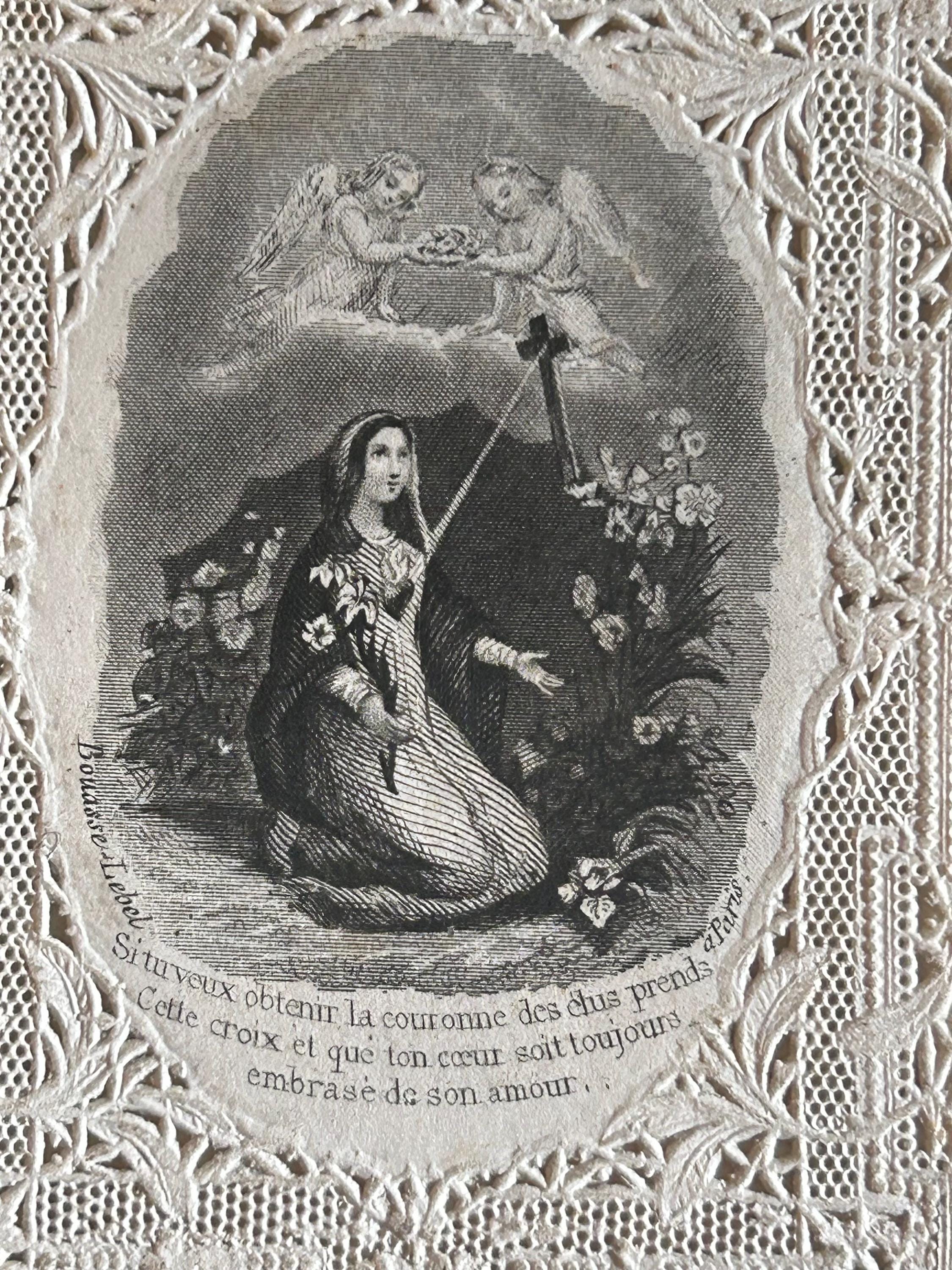
This antique, French canivet is by Bouasse-Lebel of Paris (as evidenced by the bottom left and right of the engraving on the front of the canivet. It is circa 1800s and is in very good condition with minimal loss to the cut edges. There is, however, some foxing/discoloration on both the front and reverse. Please examine all photos carefully and do let me know if you need more as I'll be happy to oblige.
The front of the canivet depicts the Virgin Mary holding lilies and surrounded by flowers with angels above her holding a crown. The text (translated from French)reads: If you wish to obtain the crown of the chosen, take this cross and let your heart always be set ablaze with His love.
The reverse of the canivet reads (in translation): Arise, Christian soul, accept with love the cross that the Lord sends you. After the trials will come rest. Walk with confidence, strengthened by grace. The immortal crown that the angels weave up above will be the reward for a few passing sorrows. There is also a reference to Bouasse-Lebel and the printing house on Rue Saint-Sulpice.
Dimensions: 2 ⅞" x 2
A bit of interesting history concerting the printing house Bouasse. Thank you to https://archivescatalog.udayton.edu/repositories/2/resources/330
"Eulalie Lebel was born in Paris in 1809, the only daughter of the printer Jacques-Auguste Lebel. In 1827 she married Francois-Marie Bouasse, a foreman at a printing house. Facing destitution when her husband abandoned her and her two children, she founded a printing house in 1845 under the name "Madame Bouasse, nee Lebel." In 1847, Maison Bouasse-Lebel moved to the Saint-Sulpice neighborhood of Paris, the center of the religious printing industry in post-revolutionary France. Eulalie Bouasse sold the now-successful company to her eldest son, Henri, in 1852. Her other surviving son, Emile, continued to work at the company. During these early years, the company produced books, maps, and other items in addition to religious images. The company received significant praise for their religious products, including a papal commendation in 1871.
In 1867 Emile left the company, and began his own printing house under the name Bouasse-Jeune. This company was also located in the Saint-Sulpice neighborhood of Paris, and a hostile relationship existed between the two brothers and their companies. The introduction of chromolithography in the 1870s was embraced by both Bouasse-Lebel and Bouasse-Jeune, and continued their competition. The two companies became known for their intricate designs, highly symbolic and detailed artwork, and innovative use of printing technologies.
Emile Bouasse passed away in 1881 at the age of 49, and his wife and children took over the company. Eulalie Bouasse-Lebel passed away in 1898. Henri Bouasse-Lebel passed away in 1912, and his company was taken over by his son Albert. Bouasse-Jeune discontinued production sometime in the beginning of the twentieth century.
Following World War II, interest in religious images began to decline, and the innovative artwork and technology pursued by the Bouasse firms slowed as well. Holy cards from this era depict less intricate artwork, or use photographic images. Albert Bouasse-Lebel passed away in 1955, and the Maison Bouasse-Lebel stopped production in the 1960s."
Thank you for looking.
Returns & Exchanges
Returns & exchanges accepted within 7 days
Buyers are responsible for return shipping costs. If the item is not returned in its original condition, the buyer is responsible for any loss in value.
I gladly accept returns, exchanges, and cancellations
Request a cancellation within: 12 hours of purchase
The following items can't be returned or exchanged
Because of the nature of these items, unless they arrive damaged or defective, I can't accept returns for:
- Custom or personalized orders
- Perishable products (like food or flowers)
- Digital downloads
- Intimate items (for health/hygiene reasons)
Questions about your order?
Please contact me if you have any problems with your order.